Yard & Lawn Pest Control
Explore Our Services
- Rodent Control & Exclusion
- Cockroach Control
- Ant Control
- Bed Bug Control
- Mosquito Control
- Lawn & Yard Pest Control
Let's Get Started
- Mon - Sat: 8:00 AM - 5:00 PM
- Parada St, Punta Gorda, FL 33982
Here is the thing that costs Florida homeowners the most money on this: chinch bug damage looks exactly like drought stress. Yellowing that turns brown, starting at the sunniest edges of the lawn. So people water more. The grass keeps dying, the water bill goes up, and by the time anyone works out what is actually happening the patch has spread across half the yard.
St. Augustine grass is the standard turf across Southwest Florida and it has a specific set of pests that go after it. Bug Off Pest treats lawns across Charlotte, Sarasota, Lee and DeSoto counties, starting with working out what is actually damaging yours, because the treatment for chinch bugs does nothing to grubs and the reverse is equally true.
What is actually eating your grass
Chinch bugs are the main event in St. Augustine. They feed with piercing mouthparts and inject a toxin as they go, which is why the damage keeps spreading outward after the insects have moved on. They want heat and dry conditions, so they start along driveways, sidewalks, south and west-facing edges and anywhere reflecting warmth. Interior lawn comes later. Peak activity runs through the warm months, which in this region is most of the year.
Tropical sod webworms are the caterpillar stage of a small moth, and they feed at night. The giveaway is the blades themselves: ragged, notched, chewed edges rather than uniform browning, and grass that looks like it was mown badly. If small tan moths flush up as you walk the lawn at dusk, that is the adult stage laying eggs for the next round.
Armyworms are the fast one. They arrive in numbers, feed heavily, and can strip visible sections of a lawn within days rather than weeks. Damage this sudden is almost always armyworms rather than anything else.
Mole crickets work below the surface, tunnelling and severing roots. The lawn feels spongy underfoot, and you will see small ridges or loose soil where they have been. More common in bahiagrass but they take St. Augustine too.
White grubs feed directly on the root system, which means the turf detaches. If you can lift a section like a loose carpet with no root holding it down, that is grubs.
Fire ants are covered in more detail on our ant control page, but the mounds and the hazard they create around children and pets belong in any conversation about a Florida yard.
How to work out which one you have
Yellowing and browning at sunny edges
Starts along driveways, sidewalks and hot exposures, expands outward, and looks identical to drought stress. Pull back the turf right at the boundary between green and brown, not in the dead area, and look at the soil surface. That is where chinch bugs sit.
Ragged, chewed blades
Spongy ground and loose soil
Turf that lifts like carpet
Our lawn pest control process
Our termite work is built around identifying the species correctly before choosing a treatment, because a subterranean treatment does nothing for drywood termites and the reverse is equally true.
Inspection & Identification
Targeted Treatment
Follow-Up & Prevention
Why choose Bug Off Pest for lawn pest control
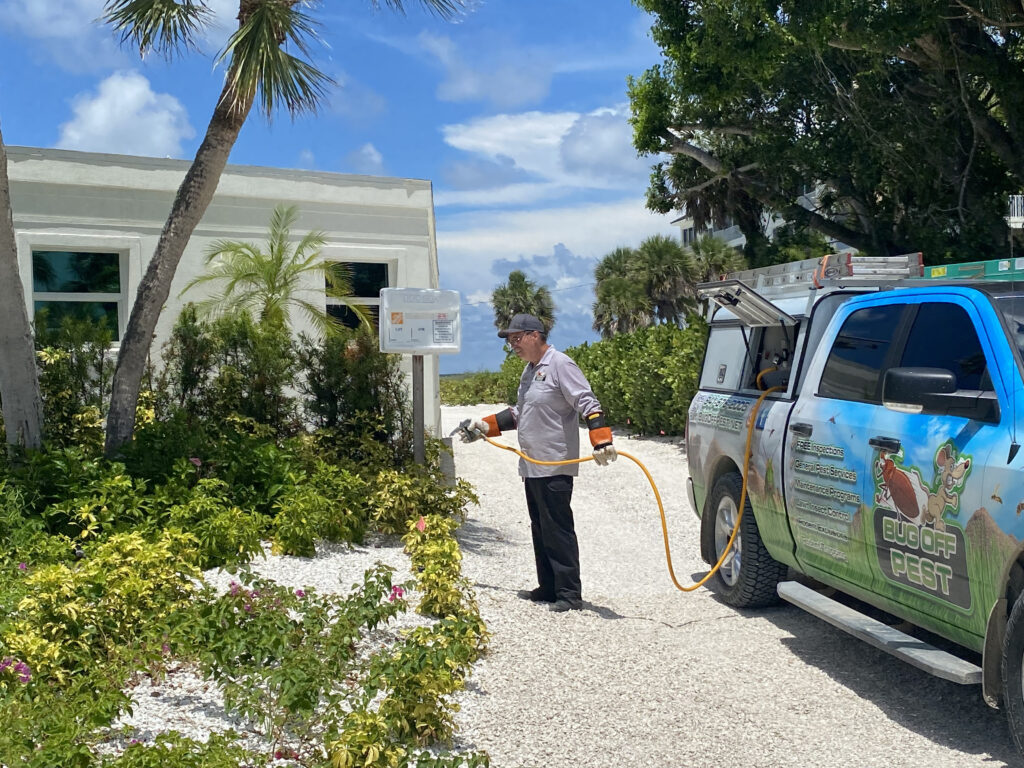
We identify before we treat, which on a lawn matters more than almost anywhere else, because four different pests produce four different kinds of damage and the wrong treatment achieves nothing. We inspect at the damage margin where the insects actually are rather than in the dead patch. And we tell you when the problem is your irrigation rather than an insect, because sometimes it is.
- Species identified before any treatment
- Applied with pets, canals and pollinators in mind
- Straight answers when it is not a pest problem
Frequently asked questions
My lawn is turning brown. Is it chinch bugs or is it just dry?
This is the most common question we get and the two look almost identical. Chinch bug damage usually starts at the hottest, driest edges: along driveways, sidewalks and south or west exposures. The reliable test is to pull back the turf right at the boundary between green and brown and look at the soil surface, since the insects sit at the advancing margin rather than in the dead area. If watering more has not helped, that itself is a signal.
Is lawn treatment included in my quarterly pest plan?
No, it is a separate service. A general household pest plan covers the structure and the perimeter for ants, roaches, spiders and similar. Lawn pest work targets a different set of insects in the turf itself and is quoted separately. Plenty of customers run both, and we will tell you honestly whether your lawn actually needs it.
Are treatments safe around pets, children and canals?
Yes, applied correctly and to label. Pets and children should stay off treated turf until it is dry, and your technician will give you the specific re-entry time. On canal-front and waterfront properties we select products and application methods with water proximity in mind, and applications avoid blooming plants and are timed around pollinator activity.
Do you also do fertilisation and weed control?
No. That is lawn care, and it is a different trade with different products and different licensing. We handle the insects damaging your grass. If your problem turns out to be nutrition, disease or weeds rather than pests, we will tell you that rather than treat for something you do not have.
How often does a Florida lawn need treating?
It depends on the pest and the property. Chinch bug pressure runs through most of the year here, and lawns with hot exposures, new sod or surrounding irrigated turf need a preventive schedule rather than reactive treatment. Established lawns with no history may only need attention when something appears. The inspection will tell you which you are.