Charlotte County sits in one of the heaviest subterranean termite zones in the United States, and the houses here – concrete slab, stucco skin, attached lanai – are built in exactly the style those termites know how to enter. So “effective” isn’t a marketing word in this trade; it’s a checklist. Here’s what termite treatment in Charlotte County involves when it’s done right, what the options actually are, and how to judge whether a proposal – ours or anyone’s – will protect your house or just your peace of mind.
Effective termite treatment in Charlotte County starts with identifying the species – subterranean termites need a soil barrier or bait system ($800–$2,500 for most homes), while drywood termites need targeted or whole-structure wood treatment. The other half is monitoring: a treatment without annual inspection behind it slowly expires.
Know your enemy first: what's eating Charlotte County
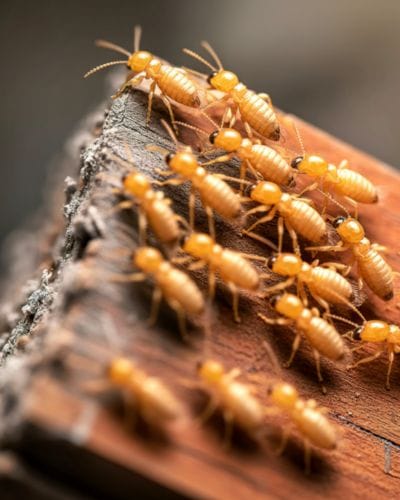
Subterranean termites (most local damage)
They nest in soil and commute into your home through slab cracks, plumbing penetrations, and the mud tubes they build up foundation walls – pencil-wide dirt straws you can see on a flashlight walk. Colonies run into the hundreds of thousands, they work 24 hours a day, and the moisture our climate provides year-round means no off-season. The Formosan variety, present in Southwest Florida, does the same job faster.
Drywood termites
No soil contact – they live entirely inside the wood they eat: fascia boards, window frames, attic framing, furniture. The telltale is frass: piles of dry pellets like coarse sand under a kicked-out hole. Different biology, completely different treatment, which is why species ID comes before any quote worth signing.
Termite treatment in Charlotte County: the options compared
| Method | How it works | Best when |
|---|---|---|
| Liquid soil barrier | Non-repellent termiticide trenched around the foundation; foragers cross it, share it, and the colony collapses | Active subterranean infestation or prevention on slab homes – the local workhorse |
| Bait system | In-ground stations the colony feeds on; growth inhibitor spreads through the nest | Ongoing protection, complex construction, or where trenching isn’t practical |
| Localized wood treatment | Borate/foam injection into confirmed drywood galleries | Small, accessible, confirmed drywood colonies |
| Whole-structure treatment | Treats all infested wood when drywood activity is widespread | Multiple drywood colonies across the structure |
What makes any of these “effective” is less the product than the completeness: a liquid barrier with a gap at the lanai slab is a fence with the gate open. That’s also the honest reason professional treatment outperforms DIY here – the products matter, but the coverage is the job.
What a real treatment process looks like
- Inspection first, always free with us. Slab lines, mud tubes, moisture readings, attic frass check, and photos of everything found – species confirmed before anything is priced.
- A written scope. Which product, how many linear feet, what the warranty covers (re-treatment only, or damage repair too), in writing.
- The treatment itself. A day’s work for most homes: trenching and treating soil, drilling slab joints where needed, or setting and registering bait stations.
- The follow-up. Activity re-checked after treatment, then annually. Termite protection is a subscription to vigilance, not a one-day event – conditions like new irrigation or landscaping can breach a barrier years early.
How to judge any termite proposal
Four questions separate real protection from paper: Did they identify the species and show you evidence? Does the price cover the whole structure perimeter, or only “affected areas”? What exactly does the warranty promise – and does it survive if you sell the house? Who comes back next year, and is that visit in the price? Any company that answers all four plainly is probably worth hiring, and Florida law gives you a check on all of them: every operator must hold an FDACS license you can verify at fdacs.gov.
The Charlotte County part of the equation
Local conditions shape local treatment. Canal-front homes in Punta Gorda Isles and coastal Port Charlotte carry constant soil moisture that keeps subterranean colonies productive all year. The county’s older slab homes have decades of settling cracks – highways to the sill plate. And the post-hurricane rebuild years put a lot of new, untreated lumber into the housing stock. We treat for what this county grows, and it’s also why we tell every homeowner the same thing: the cheapest effective termite treatment in Charlotte County is the annual inspection that makes the big one unnecessary. We covered the full price breakdown in our cost guides, and our termite control page details the plan options. The inspection is free, the quote is written, and the technicians are FDACS-licensed – since 2019. (941) 676-2005.
Common questions
How do I know if I need termite treatment or just an inspection?
If you’ve seen mud tubes, swarmers indoors, frass piles, or hollow-sounding wood, assume treatment is on the table. If you’ve seen nothing but want certainty, an inspection alone answers it – and a good company will tell you honestly when the answer is “you’re clean.”
How long does termite treatment last in Florida?
A quality liquid barrier protects five-plus years; bait systems protect for as long as they’re serviced. Annual inspections keep either honest, because soil disturbance can shorten both.
Can I stay home during treatment?
For soil barrier and bait work, yes – it’s exterior work with no need to leave. Whole-structure drywood treatments are the exception and get planned with you in advance.
Does a termite bond transfer when I sell my house?
Usually yes, and it’s a genuine selling point in this county – buyers’ inspectors ask. Confirm transferability in the warranty language before you sign, not at closing.