Pasture & Commercial Fire Ant Control
Explore Our Services
Let's Get Started
- Mon - Sat: 8:00 AM - 5:00 PM
- Parada St, Punta Gorda, FL 33982
Fire ants on acreage are not a lawn problem scaled up. Mounds in a calving paddock are a hazard to newborn stock. Mounds in a hayfield damage cutter bars and end up in the bale. Mounds around irrigation controllers, well pumps and junction boxes cause electrical failures that cost more than the treatment would have.
They are also the pest most commonly treated the wrong way. Working mound by mound across a hundred acres does not reduce a fire ant population, it relocates it. Bug Off Pest treats fire ants at scale across pastures, ranches, groves, sports fields and commercial grounds in DeSoto, Charlotte, Sarasota and eastern Lee counties.
Why fire ants behave the way they do on acreage
Red imported fire ants are established throughout Florida and they build in open sunny ground, which is exactly what pasture, hayfield, sports turf and maintained grounds provide. Shade suppresses them, so a wooded property has far fewer mounds than an open one for reasons that have nothing to do with management.
The detail that explains most of the frustration on this is colony structure. Some populations have a single queen per colony and defend territory against neighbouring mounds, which keeps mound density relatively low. Others have many queens per colony and no territorial aggression between mounds, and those populations reach dramatically higher densities on the same acreage. Multiple-queen populations are common in Florida. If your neighbour has twenty mounds and you have two hundred on similar ground, this is usually why.
It also explains why mound-by-mound treatment fails at scale. Disturb a colony without eliminating the queens and it relocates, often splitting in the process. You treat, the mound disappears, and two appear thirty feet away. Nothing has been solved.
Fire ant stings are painful and a disturbed mound produces a mass response. If you or a worker have a history of severe reaction to stings, seek medical attention promptly after a sting incident.
What fire ants cost on a working property
Livestock and foals
Hay and forage
Electrical and irrigation equipment
Grounds, fields and public areas
Our two-step approach
The standard professional method for acreage is broadcast bait combined with individual mound treatment. Neither works properly alone.
Assessment & Mapping
Broadcast Bait
Individual Mound Treatment & Review
Why Florida property owners choose Bug Off Pest
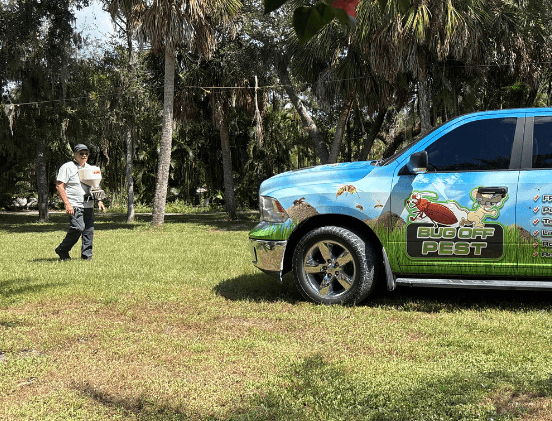
We treat fire ants at the scale the property actually needs rather than chasing mounds, we time bait application to foraging activity instead of the calendar, and we work to label requirements including grazing and haying restrictions where livestock are involved. Agricultural work is core to what we do, and we are FDACS-licensed and fully insured.
- Broadcast plus mound treatment, at acreage scale
- Timed to foraging activity, not the calendar
- Grazing and haying restrictions observed
Frequently asked questions
I treat the mounds and they just move. Why?
Because treating a mound without eliminating the queens disturbs the colony rather than killing it, and the response is to relocate, sometimes splitting into several mounds in the process. On acreage this is why mound-by-mound work feels endless. Broadcast bait is what reduces the population, because foraging workers carry it back and feed it to the queens.
How long before baits work?
Are treatments safe with livestock grazing?
Products used on pasture and hayfield carry label requirements covering grazing and haying intervals, and we work to them. Tell us your grazing rotation and cutting schedule at the assessment so treatment is planned around it rather than creating a restriction you were not expecting.
Why does my neighbour have far fewer mounds on similar ground?
Usually colony structure. Multiple-queen populations reach much higher mound densities than single-queen populations on identical ground, and both occur in Florida. Shade also suppresses them, so an open pasture will always carry more than a wooded property regardless of what either owner does.
Do you treat sports fields, HOA common areas and commercial grounds?
Yes. Sports fields, playgrounds, community common areas and commercial landscaping are treated with the same two-step approach, with priority given to the areas where people actually go. For community associations this usually sits within a broader grounds programme, which we cover on our property management page.