
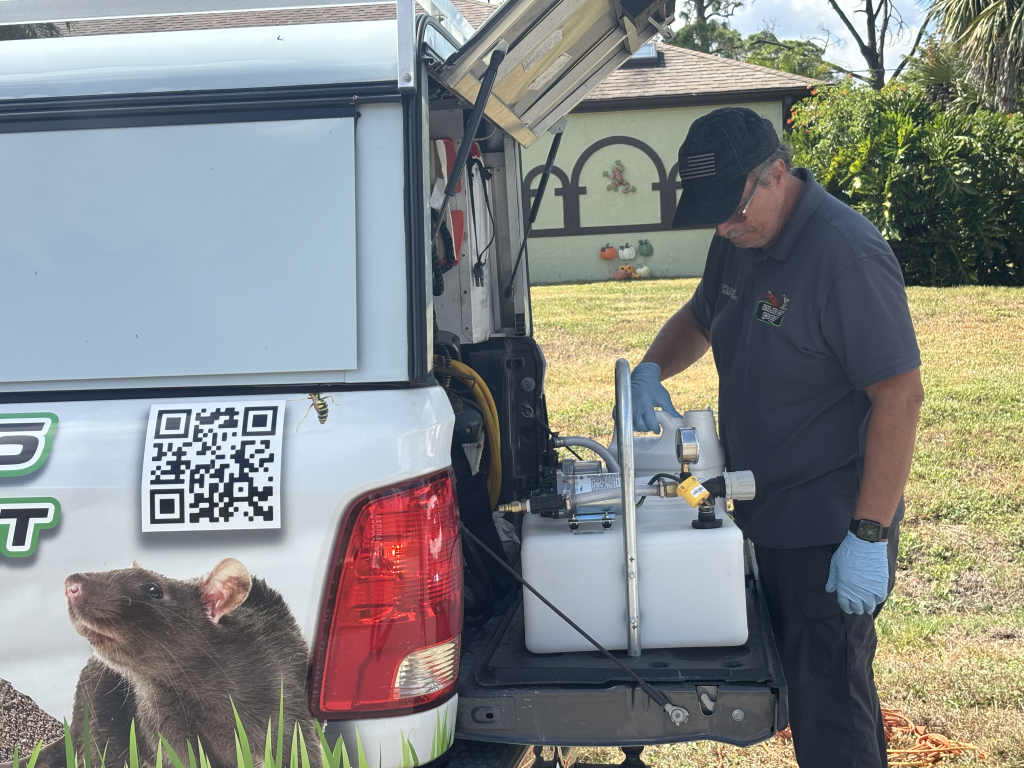
There’s a cycle we see all the time: a homeowner traps a rat in the attic, feels the relief, and three weeks later the scratching is back. New rat, same hole. You can run that loop forever, because trapping answers the wrong question. The right question isn’t “how do I catch this one?” – it’s “how did it get in?” That question is the whole idea behind exclusion pest control.
Exclusion pest control means finding and permanently sealing the openings pests use to enter a building – soffit gaps, pipe penetrations, worn door seals, vents – instead of relying on traps and sprays after they’re inside. Done right, it’s the closest thing this trade has to a one-time, lasting fix.
Traps treat the rat. Exclusion treats the hole.
Most pest control is reactive: something got in, we knock it down. Exclusion flips the order. It treats your home the way a boat owner treats a hull – you can bail water all day, or you can patch the leak. For rodents especially, the math is lopsided: a rat needs a gap about the size of a quarter, a mouse needs a dime, and a typical Florida home has a dozen candidates. Seal them all and you haven’t just solved this rat – you’ve solved the next hundred that would have followed the same scent trail to the same opening.
Where Florida homes actually leak
The ranking pages on this topic talk about “cracks in the foundation” like every house is a Chicago brick two-flat. Florida block-and-stucco construction leaks in its own specific places. These are the ones we seal most, in rough order:
| Entry point | Why it’s open | What sealing looks like |
|---|---|---|
| Garage door corners | Bottom seal wears into a curved gap at each end | New rubber seal + side weatherstripping |
| Soffit returns & gaps | Decades of expansion open the eave seams | Screened metal closures, not foam alone |
| Pipe & cable penetrations | The builder’s hole is bigger than the pipe | Sealant backed with copper mesh |
| Barrel-tile bird stops | Missing or crumbled at the roof edge | Replacement stops or screening |
| Weep holes | Required for drainage, sized perfectly for pests | Stainless weep covers that still drain |
| Attic & dryer vents | Plastic louvers break; screens rust out | Metal-screened vent covers |
| Door thresholds | Daylight visible = highway open | Door sweeps and threshold adjustment |
The materials matter more than people expect. Expanding foam by itself is a rodent chew toy – it buys weeks, not years. Real exclusion work uses metal flashing, hardware cloth, copper mesh, and sealants rated for the job, because a rat’s front teeth grow all its life and it gnaws to wear them down. If you want the full picture of how they get upstairs in the first place, our roof rat guide walks the whole route.
What a real exclusion pest control job looks like
When we do exclusion pest control on a home, it runs in a fixed order, and the order is the point:
- The inspection. Every foot of the roofline, slab line, and utility penetrations, plus the attic. We’re reading evidence – rub marks, droppings, chewed screening – to find not just openings, but the openings in use.
- Trap-out first. Here’s the counterintuitive part: you don’t seal an occupied house. Lock a rat family inside and they’ll chew a new exit through something you’ll like even less, or die in a wall. Trapping and sealing are sequenced, not simultaneous.
- Seal everything, not just the busy door. Rodents that lose their usual entrance check the alternatives within days. A job that closes three of five openings is a job that failed politely.
- Verify. A follow-up visit confirms nothing new is getting in and nothing got locked in. Good exclusion work comes with a warranty on the sealed points – ask for it in writing.
What it costs, and why it pays anyway
Exclusion pest control is priced by the job because homes leak differently – around Charlotte County, straightforward rodent exclusion typically lands in the $300 to $1,200 range depending on how many points need sealing and how much roofline is involved. That’s more than a round of traps, and it’s also the last time you pay for the problem. Compare it against the alternative: repeat trapping visits forever, plus the real risk of rodents chewing wires while you cycle. Insurance rarely covers that damage; Florida insurers file it under preventable.
There’s also a quieter benefit: every gap you seal for rats is a gap that no longer admits roaches, wasps scouting a wall void, or summer’s displaced palmetto bugs. Exclusion is the rare pest measure that keeps paying on pests you never see.
Can you do exclusion yourself?
Some of it, genuinely. A garage door seal, door sweeps, and caulking visible pipe penetrations are honest weekend work, and we’d rather you do them than not. Where DIY runs out is height and diagnosis – soffit returns and roof-edge work mean ladders at the worst angles of the house, and knowing which opening is in use (versus which just looks scary) is what the inspection is for. The UF/IFAS Extension publishes good exclusion basics if you want to study before you decide.
If you’d rather have it diagnosed properly, that part costs nothing: we inspect free, show you photos of every opening we find, and quote the sealing work in writing before anything starts. FDACS-licensed technicians, serving Punta Gorda, Port Charlotte, and all of Southwest Florida since 2019. (941) 676-2005.
Questions homeowners ask about exclusion
Is exclusion pest control worth it?
For rodents in Florida, almost always. One sealing job typically costs about the same as two or three reactive service calls, and it’s the only approach that ends the cycle instead of managing it.
How long does exclusion work last?
Properly done with metal and rated sealants, years – often the life of the materials. The exceptions are new damage (storms, settling) and new penetrations (that cable installer’s fresh hole), which is why an annual look-over keeps it honest.
Does exclusion work for insects too?
It helps a lot with the big walkers – palmetto bugs, spiders, wasps scouting entry. It can’t fully stop tiny ants or anything that flies to open doors. For those, exclusion is the supporting act and treatment is the lead.
What's the difference between exclusion and just sealing my house myself?
Sequence and diagnosis. Professionals trap out before sealing, identify which openings are actually in use, and use chew-proof materials. The most common DIY failure we see is a well-sealed house with a rat family sealed inside it.